Welcome to my blog!!!!


:) enjoy


miércoles, 23 de marzo de 2011

Easy toddler gross motor activities to build your toddler’s upper body strength as well as their balance.


toddler gross motor 2 year old toddlers are running, climbing and physically active. You can use this to your advantage by using some of these planned activities to further develop their gross motor skills at home.
Gross motor skills are necessary for walking, running, sitting and crawling and all of these become necessary later when your toddler grows up and needs to grow in physical strength as well as for the simple function of being able to sit for school work.
While writing is a fine motor skill, the gross muscles need to be strong to support the torso for the task.
Balance beams
Set up a simple balance beam in your yard with two bricks and a widish plank of wood. Get your toddler to walk across this. As they begin to master it you can add a second stack of bricks or a narrower plank.


Bean bag games
Throwing and catching bean bags is often much easier for this age group than balls which tend to run away. You can throw these to one another, your toddler can throw them into a wash basket, over a rope or onto a hole in a cardboard box for variety.


Hoop games
If you have a large enough lawn, you can roll a hula-hoop down the lawn and get your toddler to chase and catch it. When they are a little older get them to try and run through the hoop while it is still moving.


Hopping
Hopscotch, hopping up and down stairs, hopping on paving stones…all of these are great toddler gross motor activities for balance.


Jumping
At 2 years old you toddler will probably still be jumping with only one foot leaving the ground. As the year progresses they should start to lift both feet off the ground. You can encourage them to jump by playing the animal games below.


Animal games and movements
This was one of our children’s favourite games until they were well into the primary school years. Get your toddler to imitate the way certain animals walk. It’s even more fun if mom joins in! They can:


  • Slither like a snake


  • Hop like a bunny


  • Waddle like a penguin


  • Walk like a dog


  • Spring like a kangaroo


  • Running after bubbles
    On a wind free day select a large grassy area and blow bubbles for your toddler to chase and pop. This is on of the great natural toddler gross motor activities.

    Balls large throwing and catching
    Purchase some outsized balls for your toddler to roll, throw and catch.


    Ride on toys
    There is a huge selection of ride on toys for toddlers. Do not rush into buying a tricycle too soon as this is not normally age appropriate until 3.5 years.


    Climbing Frames
    Climbing frames are great fun to have in your yard for toddler gross motor activities. Choose ones that have a platform and a tent if you can as this becomes an extension for imaginary play.


    Consider Gardening...
    Gardening with your children from young is a wonderful wholesome habit to develop and it has the bonus of encouraging your children to do productive work in a fun way and build upper body strength at the same time. Take a look at Lindsey's
    www.kiddiegardens.com where she says: "Creating a toddler garden is the perfect way of ensuring your toddler can enjoy the delights of being outside and exploring nature safely. Whether you have a small garden which can be made completely toddler-proof or whether you want to design a specific toddler play area within a larger garden, you will find loads of ideas and inspirations here."

    Our Solar System


    What Is The Solar System?

    The Solar System is made up of all the planets that orbit our Sun. In addition to planets, the Solar System also consists of moons, comets, asteroids, minor planets, and dust and gas.

    Everything in the Solar System orbits or revolves around the Sun. The Sun contains around 98% of all the material in the Solar System. The larger an object is, the more gravity it has. Because the Sun is so large, its powerful gravity attracts all the other objects in the Solar System towards it. At the same time, these objects, which are moving very rapidly, try to fly away from the Sun, outward into the emptiness of outer space. The result of the planets trying to fly away, at the same time that the Sun is trying to pull them inward is that they become trapped half-way in between. Balanced between flying towards the Sun, and escaping into space, they spend eternity orbiting around their parent star.

    How Did The Solar System form?

    This is an important question, and one that is difficult for scientists to understand. After all, the creation of our Solar System took place billions of years before there were any people around to witness it. Our own evolution is tied closely to the evolution of the Solar System. Thus, without understanding from where the Solar System came from, it is difficult to comprehend how mankind came to be.

    Scientists believe that the Solar System evolved from a giant cloud of dust and gas. They believe that this dust and gas began to collapse under the weight of its own gravity. As it did so, the matter contained within this could begin moving in a giant circle, much like the water in a drain moves around the center of the drain in a circle.

    At the center of this spinning cloud, a small star began to form. This star grew larger and larger as it collected more and more of the dust and gas that collapsed into it.

    Further away from the center of this mass where the star was forming, there were smaller clumps of dust and gas that were also collapsing. The star in the center eventually ignited forming our Sun, while the smaller clumps became the planets, minor planets, moons, comets, and asteroids.

    A Great Storm

    Once ignited, the Sun's powerful solar winds began to blow. These winds, which are made up of atomic particles being blown outward from the Sun, slowly pushed the remaining gas and dust out of the Solar System.
    With no more gas or dust, the planets, minor planets, moons, comets, and asteroids stopped growing. You may have noticed that the four inner planets are much smaller than the four outer planets. Why is that?

    Because the inner planets are much closer to the Sun, they are located where the solar winds are stronger. As a result, the dust and gas from the inner Solar System was blown away much more quickly than it was from the outer Solar System. This gave the planets of the inner Solar System less time to grow.

    Another important difference is that the outer planets are largely made of gas and water, while the inner planets are made up almost entirely of rock and dust. This is also a result of the solar winds. As the outer planets grew larger, their gravity had time to accumulate massive amounts of gas, water, as well as dust.

    The Solar System Has Over 100 Worlds

    It is true that there are only eight planets. However, the Solar System is made up of over 100 worlds that are every bit as fascinating. Some of these minor planets, and moons are actually larger than the planet Mercury!

    Others, such as Io, have active volcanoes. Europa has a liquid water ocean, while Titan has lakes, rivers, and oceans of liquid Methane. You can read more about these amazing worlds by clicking here.

    The Asteroid Belt, The Kuiper Belt, And The Oort Cloud

    You have probably heard about the Asteroid Belt. This band of asteroids sits between the orbits of the planets Jupiter and Mars. It is made up of thousands of objects too small to be considered planets. Some of them no larger than a grain of dust, while others, like Eros can be more than 100 miles across. A few, like Ida, even have their own moons.

    Further out, beyond the orbit of the minor planet Pluto, sits another belt known as the Kuiper Belt. Like the Asteroid Belt, the Kuiper Belt is also made up of thousands, possibly even millions of objects too small to be considered planets. A few of these objects, like Pluto, are large enough that their gravity has pulled them into a sphere shape.

    These objects are made out of mostly frozen gas with small amounts of dust. They are often called dirty snowballs. However, you probably know them by their other name... comets.
    Every once in a while one of these comets will be thrown off of its orbit in the Kuiper Belt and hurled towards the inner Solar System Where it slowly melts in a fantastic show of tail and light.

    Beyond the Kuiper Belt sits a vast area known as the Oort Cloud. Here within this jumbled disorganized cloud live millions of additional comets. These comets do not orbit the Sun in a ring or belt. Instead, each one buzzes around in a completely random direction, and at extremely high velocities.


    Beyond The Oort Cloud

    The Sun's solar winds continue pushing outward until they finally begin to mix into the interstellar medium, becoming lost with the winds from other stars. This creates a sort of bubble called the Heliosphere. Scientists define the boundaries of the Solar System as being the border of the Heliosphere, or at the place where the solar winds from the Sun mix with the winds from other stars.

    The Heliosphere extends out from the Sun to a distance of about 15 billion miles, which is more than 160 times further from the Sun than is the Earth.


    Toddlers Games!!! :)

    toddler games

    Imaginary play is what will make up the majority of your toddlers day. Be sure to encourage it with some of my ideas.


    1. Drive-in. Pretend your home is a Drive-in Restaurant. Have Mom and kids sit in the car while Dad comes out (perhaps on roller skates) to serve hot dogs, drinks, and fruit. Play your favorite CDs in the car. Make sure you give Dad a big tip!
     
    toddler action songs
    2. Have a Halfy Birthday Party. Hold a “halfy” birthday party for each preschooler in your family (to determine the date it’s exactly six months after their real birthday). Make sure you remember each preschooler’s halfy birthday and serve half a birthday cake. Sing “Halfy Birthday to you.” Give the child a half dollar for a present. (Half Birthday cake recipe: For the cake, you use a 9 inch round pan. Cut it in half and stack it using frosting between layers and all over the outside. For candles use their birthday number plus one half of a candle.) (The idea is from Ginny McMillan.)
     
    3. “I’m Proud to be an American” Parade. Pour through your local thrift shops in search of old dance costumes, vintage clothes, and funny looking hats for a dress-up chest. Invite other kids and parents over for a kid performed parade down the sidewalk or cul-de-sac. (The idea is from Lisa Hemmingway Harris.)
     
    4. Silverware People. Knives are the dads, forks are the moms, and spoons are the babies. Allow your preschooler to use your silverware, if they are old enough. Otherwise use smooth children’s toy silverware to form imaginary families that talk to one another. You can show your preschooler how to make a “swing” for their baby spoons by using the belts attached to the high chair. Let the belts hang down below the seat for a swing. Whee!
     
    5. Skating Rink. Set up a room, without carpeting, like a skating rink. For skates allow the preschooler to wear the cover-ups for shoes that doctor’s use. Cover the room with aluminum foil and tape it down. The preschooler can make tickets, sell tickets, and have ice skating shows. Make a muff by rolling up a scarf around your hands or cutting the end off of a lunch bag.
     
    6. Swiss Alps Day. Set aside a day for a pretend trip to the Swiss Alps. Make the Swiss Alps out of your family room couch cushions. Serve Swiss cheese or yogurt for lunch. Have a yodeling contest. In fact, you could yodel your way through your day. If you have your “Swiss Alps Day” on a day after a fresh snowfall, you can make Snow Ice Cream.
     
    toddler dress up7. Winter in July. Cover a small blow up pool with whipped cream (won’t sting a preschooler’s eyes). Fill a bucket with white balloons (made into water balloons) so the preschoolers can have a summer snowball fight. Your preschoolers can make snowflakes out of paper ahead of time and you can hang them in the trees. Set up a dome tent and cover it with an old sheet that has ice blocks drawn on it. Insert a 20 pound block of ice inside the tent and you have an igloo on a hot summer day. The ice block will last for days, by the way. (Idea is from Lisa Hemmingway Harris.)
     
    8. Box Heaven. Collect and save up ten or fifteen different sizes of boxes (make sure all the staples and nails are out of them). Have your child stack them from biggest to smallest, then smallest to biggest. Some of the boxes can be very tiny. Allow them to play with the boxes and discover. See more toddler box ideas...


    Activities for baby-toddlers 8-12 months


    Nature Walks 
    take your baby out in their pram or in baby carrier each day. Talk to them about what you see.


    Chatting
     As you peel potatoes, as you do your housework or go about your day, chat to your little one all the time. A moms voice is soothing and all the time you are chatting you are developing neural pathways in your baby’s brain.
     
    Balls
    Once your baby is sitting you can buy a variety of different sized balls (none small enough to fit into their mouth!) and roll balls back and forth to one another.
     
    Board books
    Board books are fantastic as they do not tear and can stand a fair amount of “mouthing” by babies. Choose ones with clear open pictures.
     
    Peek-a-boo games
    Using hands, a handkerchief or a blanket, play peek-a-boo with your baby.
     
    Turning lights on and off
    This activity, which may seem very simple, was of great fascination to all my babies and was a lifesaver when I needed to distract a tired or hungry baby for a few minutes. The sentences: “Light on” and “light off” also became one of our babies first ones.
     
    Mirror games
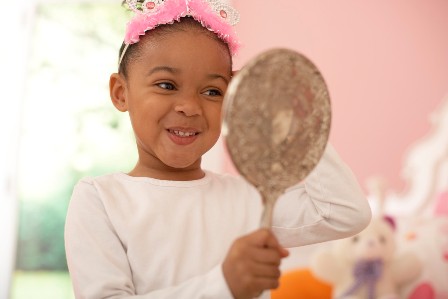
    Safety mirrors are wonderful to have in your baby’s toy box but you can also use proper mirrors when you are able to supervise the play. Go through your baby’s facial features with them while you hold a mirror for them to look into.


    Hiding toys
    Babies love to get little surprises. Take their favourite toy and hide it under a handkerchief. Ask them the question: “Where is [Pooh Bear]?” And then uncover the toy with a flourish. Repeat often and soon they will be copying you!
     
    Peep tube
    Use and old Pringles chip or similar container and peep through the tube at your baby. You can ask them the question: “Where is [Sarah]?” a few times over until you make eye contact.
     
    Round and round the garden like a teddy bear
    Action songs and rhymes are great fun. This is one of our favourites. After doing this a few times over your baby should ask you for it with their index finger on their own hand.
     
    Cycling legs
    When changing your baby’s nappy or any other time you have a moment when they are lying on their backs, gently take their feet and make cycling motions with their legs. Do not force them if they resist.
     
    Bouncing ball
    We had a large physio ball (some use them for Pilates) that we used to roll and bounce our babies on. For rolling place them tummy down and hold their feet firmly. Roll them forward making sure their arms are extended in front of them. This develops their parachute reflex which they will need when they begin to walk.
     
    Crawling obstacle course
    stack up piles of pillows or make a box tunnel for them to crawl through and over.
     
    Row row row your boat
    with your sitting babe place them directly in front of you. Hold their hands and gently ease them forward and back singing this favourite childhood song.
    Teaching body part names – Teach your baby their body part names. Get them to first identify them with repetition. Then ask them where they limb is, follow this with asking them to find your [nose-hand-foot] etc.
     
    Naming objects
    As you walk around your house teach your baby the names of objects.
    Family photo book – Take clear photos of all in your family that your baby has regular contact with. Stick them onto stiff card and bind together. Flip through this book with your baby to teach them family members names.


    Gross Motor Activties For Toddlers

    Easy toddler gross motor activities to build your toddler’s upper body strength as well as their balance.


    2 year old toddlers are running, climbing and physically active. You can use this to your advantage by using some of these planned activities to further develop their gross motor skills at home.
    toddler gross motorGross motor skills are necessary for walking, running, sitting and crawling and all of these become necessary later when your toddler grows up and needs to grow in physical strength as well as for the simple function of being able to sit for school work.
    While writing is a fine motor skill, the gross muscles need to be strong to support the torso for the task.
    Balance beams
    Set up a simple balance beam in your yard with two bricks and a widish plank of wood. Get your toddler to walk across this. As they begin to master it you can add a second stack of bricks or a narrower plank.


    Bean bag games
    Throwing and catching bean bags is often much easier for this age group than balls which tend to run away. You can throw these to one another, your toddler can throw them into a wash basket, over a rope or onto a hole in a cardboard box for variety.
     
    Hoop games
    If you have a large enough lawn, you can roll a hula-hoop down the lawn and get your toddler to chase and catch it. When they are a little older get them to try and run through the hoop while it is still moving.
     
    Hopping
    Hopscotch, hopping up and down stairs, hopping on paving stones…all of these are great toddler gross motor activities for balance.

     
    Jumping
    At 2 years old you toddler will probably still be jumping with only one foot leaving the ground. As the year progresses they should start to lift both feet off the ground. You can encourage them to jump by playing the animal games below.

     
    Animal games and movements
    This was one of our children’s favourite games until they were well into the primary school years. Get your toddler to imitate the way certain animals walk. It’s even more fun if mom joins in! They can:

  • Slither like a snake

  • Hop like a bunny

  • Waddle like a penguin

  • Walk like a dog

  • Spring like a kangaroo


  • Running after bubbles
    On a wind free day select a large grassy area and blow bubbles for your toddler to chase and pop. This is on of the great natural toddler gross motor activities.

     
    Balls large throwing and catching
    Purchase some outsized balls for your toddler to roll, throw and catch.

     
    Ride on toys
    There is a huge selection of ride on toys for toddlers. Do not rush into buying a tricycle too soon as this is not normally age appropriate until 3.5 years.


    Climbing Frames
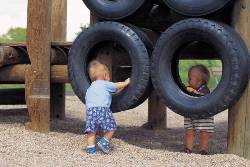
    Climbing frames are great fun to have in your yard for toddler gross motor activities. Choose ones that have a platform and a tent if you can as this becomes an extension for imaginary play.

     
    Consider Gardening...
    Gardening with your children from young is a wonderful wholesome habit to develop and it has the bonus of encouraging your children to do productive work in a fun way and build upper body strength at the same time. Take a look at Lindsey's
    www.kiddiegardens.com where she says: "Creating a toddler garden is the perfect way of ensuring your toddler can enjoy the delights of being outside and exploring nature safely. Whether you have a small garden which can be made completely toddler-proof or whether you want to design a specific toddler play area within a larger garden, you will find loads of ideas and inspirations here."


    Fine Motor Skills For Toddlers!

    Spray bottle
    Fill an empty spray bottle with water. Show your toddler how to spray out a mist with their index finger in the lever.

    Sponges
    On a warm day give your toddler a bowl of water with a variety of sponges in it. Show them how to squeeze the water out of the sponge with their fingers. This is one of the easiest fun toddler fine motor activities.

    Lacing Shapes
    Cut out some basic shapes from thick card, footprints, cat face etc. Punch holes around the edge about 2cm apart. Give your toddler a plastic blunt needle threaded with wool and let them lace the edges fo the cut out.

    Puzzles
    Puzzles with big pieces are great for your toddler to do. Choose 4, 6 and 8 piece packs that have large pieces. Make sure your toddler can sit comfortable and that your surfaces even. Choose puzzles that are relevant to your toddler’s interests. When these have been mastered choose packs that contain 12, 18 and 24 pieces.
    Encourage your toddler to look for the straight edges first. They may be impatient and you need to be patient with them, but finding the straight edge is also a visual discriminatory process which is valuable. Puzzle building should continue through all of your child's young years as it is a great fine motor activity.
     
    Cutting/Tearing Activities
    The following ideas can be used, remember though that your attention span is much longer than a toddlers!
  • Give your toddler coloured paper to tear or cut with safety scissors in strips.

  • Give them big clear outlined pictures to cut out

  • Choose a theme and cut out pictures from magazines together and stick them onto card as a collage


  • Key game
    If you have a handy man in your family ask them if they can make you a series of little doors mounted onto a frame with differing latches and keys for your toddler to open and close. We used to have this activity at a moms and tots group and it was valuable for small wrist movements.

    Lids on containers
    Save your empty, washed plastic containers and lids. Keep these in a box where your toddler can match lids and containers and learn to screw them on and off.

    Pegs
    One of the great toddler fine motor activities! Take a medium square of hard corrugated cardboard (from and old box) and a few wooden pegs. Make sure they are the ones that your toddler can squeeze together on one end so the other opens. Show them how to peg them on and off the edge of the cardboard.

    Spaghetti
    Take an empty spice shaker and fill it with a few pieces of uncooked lengths of spaghetti. Show your toddler how to unscrew the top, remove the spaghetti, replace the lid and then place the spaghetti back in the bottle through the holes in the lid. NOTE Once my one child tried to eat a piece of dry spaghetti and it got stuck in her throat. With a little coughing and some water it was dislodges quite easily, but do be aware of this if you see your toddler putting some in their mouth.

    Playdough
    Playdough is such a wonderful tactile activity for toddlers. In the beginning some may like to try to eat it, and while this is not ideal, small amount will not harm them. Purchase some cookie cutters, a small rolling pin and add some plastic non-serrated knives and your toddler is set for a whole lot of fun. Some children's toys stores also sell playdough syringes that you can fill with playdough and squeeze out the other side. This does take a fair amount of muscle power but by 2.5 years your toddler will master it.


    toddler fine motor

    Teacher's Roles


    Teacher's Role

    The teacher’s role in understanding students’ needs, and engaging them in their learning experiences includes:
    · learning about the students and their interests, abilities and learning styles
    · planning classroom environment and routines
    · organizing classroom facilities and resources
    · planning and organizing for instruction
    · planning and organizing for assessment and evaluation
    · planning for communication with students’ families
    · reflecting upon the effectiveness of their planning, instruction and assessment as a means of gathering information about their students’ progress and instructional needs, and the success of their practice.


    Learning About the Students

    One important aspect of planning and organizing for instruction is acquiring an understanding of the students. While talking directly with each student provides information about how each student perceives himself or herself as a learner, it is also useful to:

    · administer oral or written diagnostic questionnaires or surveys to assess students’ current skills, abilities, attitudes and interests
    · consult available personnel, student portfolios and records from previous years
    · consider the potential for using previously successful adaptations with each student, and plan other adaptations that address specific students’ learning requirements.

    Instruction and learning are both improved when teachers take every opportunity to learn about their students’ strengths and needs. The diagnostic information gathered allows teachers to individualize instruction and assessment to meet the needs of each student.


    Planning Classroom Environment and Routines

    Another aspect of planning and organizing for instruction involves establishing the classroom environment and routines conducive to learning.
    Teachers are encouraged to include students in setting some of the routines and expectations for use of classroom spaces, and for participating appropriately as a community of learners. When establishing positive environments and clearly defined routines, it is important to:
    · ensure students feel safe enough to take risks when expressing their ideas or attempting new learning experiences
    · establish roles and expectations for group members during collaborative and cooperative discussion and activities
    · establish expectations for independent learning experiences
    · involve students in determining some expectations and routines so that they take ownership and responsibility for adhering to them
    · explain and discuss the regular use of learning and assessment tools (e.g., learning logs/notebooks, computers and computer programs, portfolios, checklists).


    Organizing Classroom Facilities and Resources

    Some suggestions for organizing classroom facilities and resources to support the philosophy of learning advocated in this curriculum guide include:
    · Arrange the classroom furniture to accommodate both group and individual student activity. Clusters of desks or large round tables facilitate large and small group interaction, while single desks and secluded nooks provide places for individuals to work and learn independently.
    · Collaborate with the teacher-librarian or other personnel to develop a classroom resource collection that supports the current unit of study.
    · Reserve at least one wall or bulletin board area for displays related to the current unit of study. Encourage students to contribute to the display.
    · Designate display areas for students’ projects and multimedia products.


    Planning and Organizing for Instruction and Assessment

    Saskatchewan Learning has identified the amount of instructional time that must be allocated to each Specified Area of Study. Teachers are expected to provide 100 hours of instruction for Psychology 20.


    Communicating with Students’ Families

    It is important to establish regular, positive communication with students' families. The following suggestions may be helpful:
    · involve students in establishing procedures for regular communication with their families
    · provide opportunities for significant, relevant involvement of parents in classroom activities and learning experiences
    · acknowledge and be sensitive to the diversity of family structures, and to the economic, ethnic and cultural backgrounds of family members
    · encourage the exchange of informal notes and telephone calls between family members and the teacher
    · arrange in-home visits to get to know parents and caregivers, and encourage them to ask questions and to discuss students' progress reports
    · use available technology (e.g., post, e-mail, Internet) whenever possible to enhance communication with family members
    · invite students’ parents/caregivers or other family members to volunteer in the classroom or school, in capacities that make them feel comfortable and feel that their contribution is worthwhile, but be aware of and sensitive to such matters as family schedules and availability.


    Reflecting Upon Practice

    Whether beginning the second year or second decade of their careers, teachers benefit from the accumulated understanding that is the result of reflection on past practice and experience. In the contexts of their classrooms, teachers are asking questions and gathering information that continues to shape their practices as they apply what they discover to subsequent classroom teaching and learning situations.
    Teachers who approach each day as reflective practitioners consider what they know and believe about aspects of their daily practice such as:
    · students: their interests, strengths, needs, personal learning goals, etc.
    · curriculum: philosophy and expectations, aim, goals, instruction/assessment suggestions, etc.
    · their own philosophy: about instruction/ assessment, and how theirs is similar or different to that of the curriculum
    · their own reflective practices: what they reflect upon, why they choose those areas, what requires reflection next, etc.